MUSIC VIDEO CASE STUDY
ICE CUBE — BOP GUN (ONE NATION).
Ice Cube featuring George Clinton — Bop Gun (One Nation)
DESIGN & DIRECTION / MUSIC VIDEO CASE STUDY
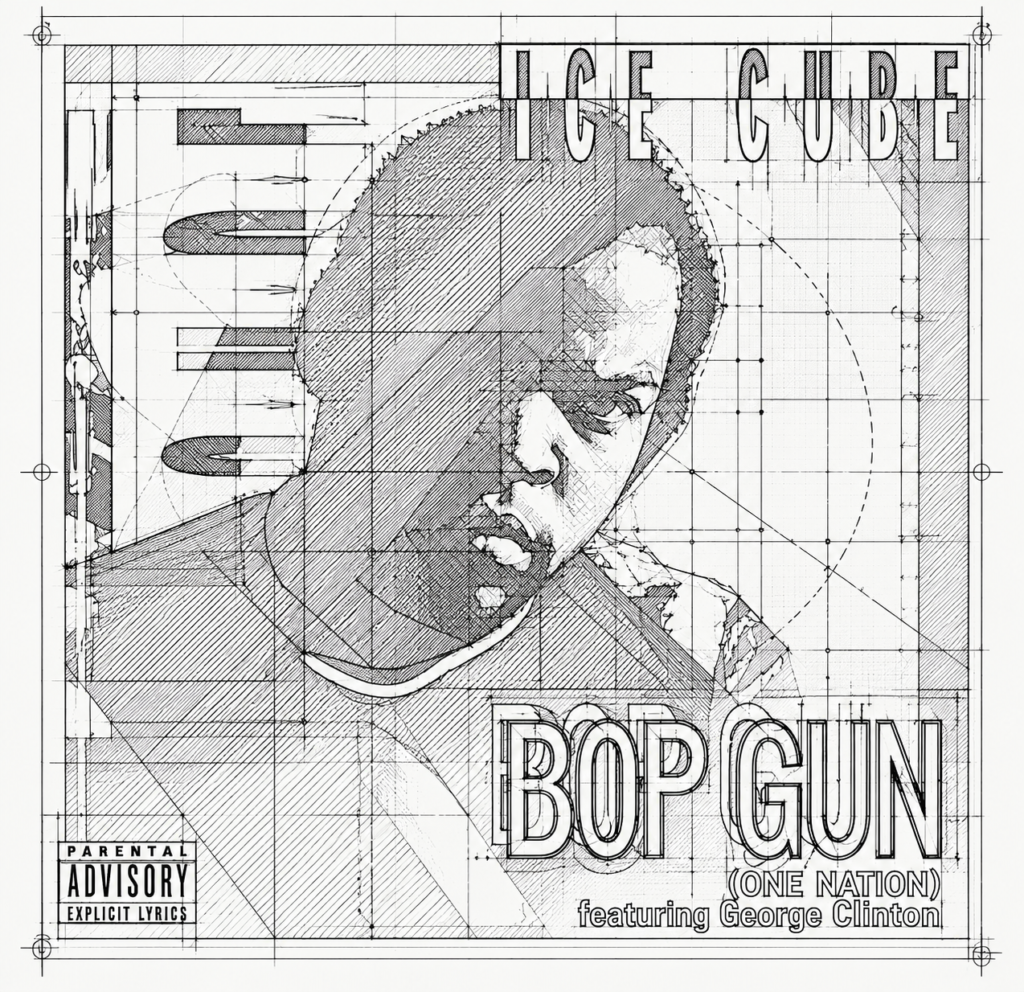
THE ORIGINAL FILM
Watch the video.
THE STORY
THE STORY
Behind the Music Video: Bringing Two Generations of Culture Together
There are certain projects you work on that stay with you long after the cameras stop rolling. For me, directing Ice Cube’s “Bop Gun (One Nation)” was one of those experiences.
At the time, I had no idea the record would become such a significant hit or that the video would become one of the more memorable projects of my directing career. I just knew I loved the song the first time I heard it.
Back in the early 1990s, record labels would send directors cassette tapes or CDs of new music. There were no streaming links or instant file transfers. You would receive the music, listen to it, and begin imagining what the artist’s world might look like on film.
When I heard “Bop Gun,” I immediately connected with the combination of Ice Cube’s unmistakable West Coast rap style and the legendary funk sound of George Clinton and Parliament-Funkadelic. I wanted the video to celebrate both worlds—not simply by putting the artists together in front of a camera, but by creating an environment where their music, personalities, and cultural influences could come together naturally.
THE CREATIVE CONCEPT
A Small House. A Bigger World.
The idea started with a simple visual contrast. At the beginning of the video, Ice Cube receives a phone call from George Clinton, inviting him to a party. Cube drives through a neighborhood and arrives at what appears to be a tiny, unassuming house—almost a shack. Nothing about the exterior suggests anything particularly exciting is happening inside.
He walks up, knocks on the door, and enters. Then everything changes. Suddenly, he is transported into an enormous, extravagant party filled with music, dancers, beautiful women, skateboarders, DJs, and personalities from the worlds of funk and West Coast hip-hop.
The little house becomes a gateway into an entirely different universe. I loved that juxtaposition. The contrast between the ordinary neighborhood exterior and the extraordinary world waiting behind the door gave the video an almost dreamlike quality.
For the exterior, we filmed a small house in a local Los Angeles neighborhood. For the party, we rented a beautiful property high in the Hollywood Hills. Two completely different locations became one continuous experience through editing, production design, and the audience’s imagination. We were creating illusions with real locations, practical effects, and creative camera work.
DESIGNING THE PARTY
Bringing Street Culture and Funk Together
The party itself was the heart of the video. I wanted it to feel like a genuine West Coast gathering, but with the theatrical energy and outrageous personality of the Parliament-Funkadelic universe.
We spent considerable time assembling the right cast. Dancers, models, skateboarders, DJs, musicians, and personalities from the local scene all contributed something different. The goal was to create a diverse, energetic crowd that felt authentic rather than staged.
There were different visual worlds throughout the house. Cube could be surrounded by women in one room, performing with his crew in another, or moving through a completely unexpected scene behind the next door. We incorporated lowrider culture, including a car with hydraulics revealed inside one of the rooms, along with DJs, dancing, street fashion, and references to Southern California hip-hop.
I wanted every room to offer another surprise. The visual language was deliberately exaggerated, colorful, and surreal—a party that could only exist when Ice Cube’s world collided with George Clinton’s imagination.
I remember the crew genuinely enjoying the shoot. The music was infectious, the cast was having fun, and the atmosphere had a life of its own. Sometimes, as a director, you work hard to manufacture energy for the camera. On “Bop Gun,” much of that energy was already there. My job was to capture it and give it visual structure.
WORKING WITH THREE LEGENDS
Ice Cube, George Clinton & Bootsy Collins
One of the most special aspects of the project was having Ice Cube, George Clinton, and Bootsy Collins involved. By that point, George and Bootsy were already legends. Parliament-Funkadelic had helped create the musical foundation that so much West Coast hip-hop was building upon.
To have them appear alongside Ice Cube was more than a cameo opportunity. It was a chance to celebrate the artists who had helped shape the sound of a new generation.
Cube and I worked closely on the creative direction, incorporating references and ideas that reflected his personality and the culture surrounding the record. I wanted him to remain unmistakably Ice Cube—confident, grounded, and authentic—even inside this outrageous, almost psychedelic world.
George and Bootsy brought an entirely different visual energy. Their presence connected the video to the history of funk, while Cube and his crew represented the contemporary West Coast movement. We weren’t just combining musical styles. We were bringing together the people who had created them.
THE PRACTICAL EFFECTS
Making the Impossible Feel Real
I have always enjoyed creating visual effects physically, in front of the camera, rather than relying entirely on postproduction.
One of my favorite ideas involved building a special boom-arm rig that allowed us to lift Ice Cube above a group of women below him. I wanted him to appear almost weightless, floating over the party. We physically attached him to the rig and elevated him over the scene, creating the illusion directly on set.
We also designed sequences around Cube moving from room to room, opening doors to reveal entirely different scenes, including the lowrider with its hydraulic suspension. These effects were achieved through physical staging, set design, camera placement, and editing.
There is something especially entertaining about an illusion that actually exists in front of the lens. The audience may not understand how it was accomplished, but the image has a physical presence that makes it feel more believable. In a video as playful as “Bop Gun,” that sense of surprise was essential.
THE CULTURAL CONNECTION
More Than a House Party
In the early 1990s, parties were one of the places where culture came together. Long before social media, people discovered music, fashion, personalities, and new ideas by gathering in physical spaces. Neighborhood parties, clubs, skate scenes, and music events were where different communities connected.
I wanted the party in “Bop Gun” to reflect that feeling. It wasn’t meant to be an exclusive celebrity event. It was supposed to feel like a celebration where different people, styles, and generations could come together around the music.
That idea was especially meaningful given the record’s message. At a time when street violence was a major part of the national conversation surrounding hip-hop, “Bop Gun” offered a different kind of energy. The Bop Gun, rooted in P-Funk mythology, wasn’t about violence. It was about the power of music to make people dance.
Instead of separating people, music could bring them together. In many ways, that is what I was trying to express visually. The house became a place where everybody belonged, and the music became the common language.
THE IMPACT
A Video That Stayed With Me
When we finished the video, I knew we had created something entertaining and visually distinctive. What I didn’t know was how far the record would go. I remember seeing the video receive significant rotation on MTV and watching the song climb the charts.
But what stayed with me wasn’t simply the commercial success. It was the experience of working with those artists, bringing those different cultural influences together, and creating a visual world that celebrated the music.
I’ve directed many music videos throughout my career, but “Bop Gun” remains one of my favorites—partly because of the song, partly because of the artists, and partly because everyone involved seemed to genuinely enjoy being part of it.
You can design the concept, select the locations, cast the performers, build the effects, and choreograph the camera movements. But occasionally, all those elements come together and create something that feels bigger than the production itself. That’s what I remember about “Bop Gun.”
THE REFLECTION
Culture Is Something You Bring Together
More than thirty years later, I look at this video differently. At the time, I was focused on making a great music video—something original, entertaining, and worthy of the artists and the song. Today, I see a larger idea behind what we created.
George Clinton and Bootsy Collins represented a musical movement that had influenced an entire generation. Ice Cube represented another generation taking those influences and transforming them into something new. My role as director was to design a world where those two generations could meet.
That principle has followed me throughout my career, from music and filmmaking to brand development, business strategy, and the design of places and experiences. The most meaningful creative work doesn’t always invent something entirely new. Sometimes it recognizes cultural energy that already exists and creates the right environment for it to connect, evolve, and reach new people.
That idea has become part of my broader creative philosophy—what I call Resonance Architecture. People create culture. Places bring people together. And great creative work gives those connections a life beyond the moment.
When I watch “Bop Gun” today, I still see the energy, humor, music, and visual experimentation that made it such a pleasure to direct. But I also see something I didn’t fully appreciate at the time: a cultural handoff between generations. And I was fortunate enough to help bring it to life.
“Bop Gun wasn’t just a music video. It was a celebration of the music, people, and culture that brought two generations together.”
— Cameron Casey
04 / BEHIND THE SCENES
WORKING WITH THREE LEGENDS Ice Cube, George Clinton & Bootsy Collins
One of the most special aspects of the project was having Ice Cube, George Clinton, and Bootsy Collins involved. By that point, George and Bootsy were already legends. Parliament-Funkadelic had helped create the musical foundation that so much West Coast hip-hop was building upon.
To have them appear alongside Ice Cube was more than a cameo opportunity. It was a chance to celebrate the artists who had helped shape the sound of a new generation.
Cube and I worked closely on the creative direction, incorporating references and ideas that reflected his personality and the culture surrounding the record. I wanted him to remain unmistakably Ice Cube—confident, grounded, and authentic—even inside this outrageous, almost psychedelic world.
George and Bootsy brought an entirely different visual energy. Their presence connected the video to the history of funk, while Cube and his crew represented the contemporary West Coast movement. We weren’t just combining musical styles. We were bringing together the people who had created them.
